

Duo Petzl upgrades - Illuminators
On the Tests and comments page: Ni-MH rechargeables or alkaline batteries - which is better?
Single Superleds
Superled for the Petzl Duo

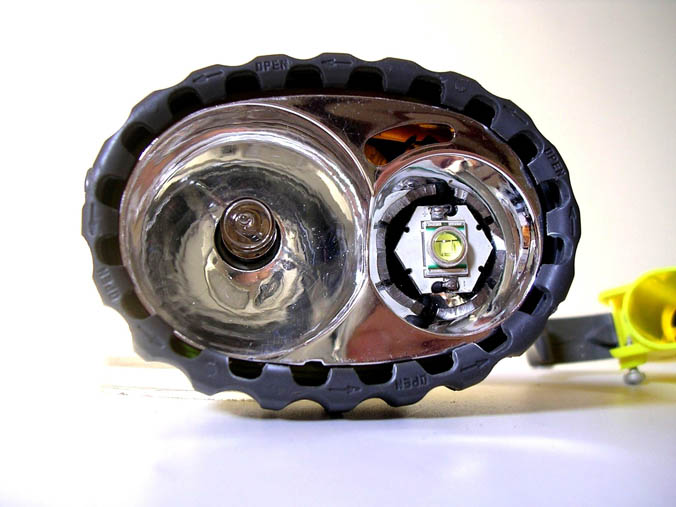

White Superled designed for the Petzl Duo lighting system. It replaces the emergency bulb and is widely used as a progression light.
- Type of light
- diffused
- Light output
- 100 lumens
- Beam angle
- 100 degrees
- Voltage
- 6 V DC
- Power supply
- 4 AA batteries, alkaline or rechargeable
- Burn time
- with 2500 mAh Ni-MH rechargeables: 12 hours at 100 lumens + 72 hours fading from 100 to 0 lumens
- Average life
- 100,000 hours
No interference with the compass when surveying.
Micro-zoom for the Petzl Duo

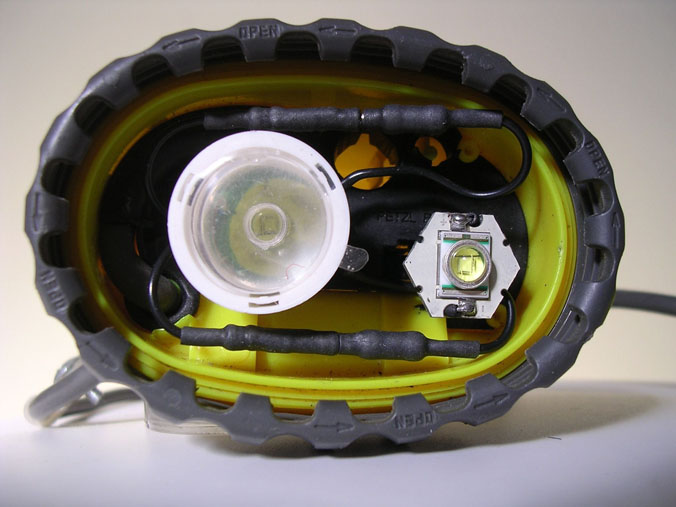

White Superled with integrated micro-optics, designed for the Petzl Duo lighting system. It is a better replacement for the halogen bulb, giving longer burn time and more light. Pair it with the diffused-light Superled for an all-Superled lamp. The reflector is no longer needed.
Fitting: remove the halogen bulb and plug the cable with the special connector into the halogen bulb socket. The Micro-zoom then simply sits on the base of the Duo with no mounting hardware.
- Type of light
- focused
- Luminous intensity
- 5000 cd
- Beam angle
- 10 degrees, reaching up to 100 m
- Voltage
- 6 V DC
- Power supply
- 4 AA batteries, alkaline or rechargeable
- Burn time
- with 2500 mAh Ni-MH rechargeables: 4 hours at 5000 cd + 72 hours fading from 5000 to 0 cd
- Average life
- 100,000 hours
No interference with the compass when surveying.
Superled for the Petzl Laser


White Superled designed for the Petzl Laser lighting system. It replaces the standard bulb and is widely used as a progression light.
- Type of light
- diffused
- Light output
- 100 lumens
- Beam angle
- 100 degrees
- Voltage
- 4.5 V DC
- Power supply
- AA batteries, alkaline or rechargeable
- Burn time
- with 2500 mAh Ni-MH rechargeables: 12 hours at 100 lumens + 72 hours fading from 100 to 0 lumens
- Average life
- 100,000 hours
No interference with the compass when surveying.
Superled modules
Superled SE module for the Petzl Duo

This module is a good, economical alternative to the Superled + Micro-zoom pair for the Petzl Duo. It uses the same board and LEDs as the Superled-3 modules, without the SW electronics.
To fit it, remove the reflector and the bulbs (or LEDs) of the old Petzl Duo and put in their place the board carrying the Micro-zoom and the two diffused-light progression Superleds. It connects through special plugs that fit into the bulb sockets.
Specifications
- Progression light
- twin 100° diffused light with a single level giving 120 lumens in total
- Progression burn time
- 10 hours at 120 lumens + 72 hours fading from 120 to 0 lumens (AA alkaline batteries)
- Micro-zoom
- 10° focused beam with a luminous intensity of 5000 cd
- Micro-zoom burn time
- 4 hours at 5000 cd + 72 hours gradually fading from 5000 to 0 cd (AA alkaline batteries)
- Power supply
- alkaline batteries or Ni-MH rechargeables
- Average life
- 100,000 hours
No interference with the compass when surveying.
Other versions available:
- Superled HSE with hybrid progression light (4500 K), 120 lumens - 9 hours burn time.
- Superled WSE with warm progression light (3000 K), 120 lumens - 8 hours burn time.
Superled-3 SWLT module
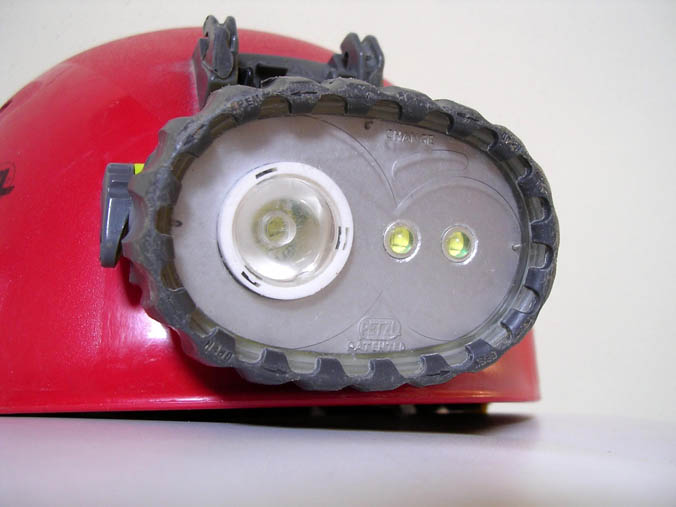
In addition to the Micro-zoom, the Superled-3 SWLT module offers 4 light levels for the progression lights:
| Level | Output | Burn time |
|---|---|---|
| 1 - Progression | 120 lumens | 12 h |
| 2 - Emergency | 3 lumens | 200 h |
| T - Mastrel-Test | battery test by light pulses | - |
| 3 - Maximum power | 300 lumens | 4 h |
To move from one level to the next, switch the progression lights off and on again within 2 seconds.
The Mastrel-Test
The Mastrel-Test lets you check the remaining burn time at any moment without taking your helmet off. It is optimised for alkaline batteries. The test is a series of light pulses at 1-second intervals. The number of pulses, from 1 to 10, depends on the state of charge of the batteries. For example: 10 pulses means the batteries are 100% charged, 6 pulses 60%, 1 pulse 10%.
Recommended for checking at home how much burn time is left before a caving trip. In that case:
- Switch the progression lights on at Level 1 (120 lumens) for about 3 minutes. This removes the initial overvoltage that would distort the test (otherwise every battery looks good).
- Select level T and run the test.
- With well-charged batteries you should get at least 9 pulses with alkalines and 7 pulses with Ni-MH rechargeables.
The Superled-3 SWLT module in the Cave of the Giant Crystals, Naica (in Italian) (PDF, 1.2 MB)
Superled-3 SW4T
The Superled-3 SW4T version adds a 40-lumen Progression2 level, to reduce glare and for small passages.
| Level | Output | Burn time |
|---|---|---|
| 100° diffused progression light | ||
| 1 - Progression1 | 120 lumens | 12 h |
| 2 - Progression2 | 40 lumens | 40 h |
| 3 - Emergency | 3 lumens | 200 h |
| T - Mastrel-Test | battery test by light pulses | - |
| 4 - Maximum power | 300 lumens | 4 h |
| Depth light | ||
| Micro-zoom | 5000 cd, 10° | - |
Superled-3 SW2T
The Superled-3 SW2T version has just the 2 main progression levels and the battery test.
| Level | Output | Burn time |
|---|---|---|
| 100° diffused progression light | ||
| 1 - Progression1 | 120 lumens | 12 h |
| 2 - Emergency | 3 lumens | 200 h |
| T - Mastrel-Test | battery test by light pulses | - |
| Depth light | ||
| Micro-zoom | 5000 cd, 10° | - |
Warm light
Alongside the white-light Superled-3 SW family there are also the warm-light Superled-3 WSW modules, whose light matches acetylene. The yellow filters inside the warm-light Superleds reduce light output by about 20%. To compensate, power consumption is slightly higher and the average burn time (at the 120-lumen progression level) drops from 12 to 10 hours.
Hybrid light

The new family of hybrid Superled-3 HSW modules is also available. In these modules one progression Superled gives white light and the other warm light. Mixing the two produces a pleasant natural light at 4500 K.
This "hybrid" light sits halfway between acetylene light and white LED light, yet keeps all the main advantages of both. Average burn time is about 11 hours.
Superled-3 SWZmix module
The Superled-3 SWZmix module for the Duo is a special version of the Superled-3 SW4T. The traditional Progression1 level is replaced by the new Zmix level, which uses the diffused light of the 2 progression LEDs and the Micro-zoom at the same time.
At this level the Micro-zoom adds an extra 1000 cd spot, enough for good vision at short and medium range. Turning the Duo switch upwards still gives you the Micro-zoom on its own at 5000 cd, to use as a depth light.
Some of the most important advantages of the new Zmix progression level:
- Better route-finding on exposed sections.
- Better visibility in squeezes and passages.
- The fixed 1000 cd spot saves you constantly switching the Micro-zoom on and off to see details.
- Safer progression in caves overall.
| Level | Light | Burn time |
|---|---|---|
| Progression light | ||
| 1 - Zmix | 100 lumens diffused light 100° + 50 lumens Micro-zoom 1000 cd, 10° beam | 10 h |
| 2 - Progression2 | 50 lumens, diffused light only, 100° | 30 h |
| 3 - Emergency | 3 lumens, diffused light only, 100° | 200 h |
| T - Mastrel-Test | battery test by light pulses | - |
| 4 - Maximum power | 300 lumens, diffused light only, 100° | 4 h |
| Depth light | ||
| Micro-zoom | 5000 cd | 4 h |


White light? Warm light? Hybrid light?
We are often asked about this, so here is our answer:
- White light gives a longer burn time and is better suited to exploration. It also gives better results for photography.
- Warm light suits those who miss acetylene light, and situations where you want to bring out particular features of the cave.
- Hybrid light is a compromise that has proved popular mainly for sport caving in heavily decorated caves.
Either way, remember that the human eye adapts perfectly to all these types of light, without any eye strain.
| Model | Diffused progression light 120 lumens | Diffused anti-glare light 40 lumens | Diffused emergency light 3 lumens | Battery test | Diffused light, maximum power 300 lumens | Micro-zoom 10° 5000 cd |
|---|---|---|---|---|---|---|
| Superled-3 SW | yes | no | no | no | no | yes |
| Superled-3 SW2 | yes | no | yes | no | no | yes |
| Superled-3 SWLT | yes | no | yes | yes | yes | yes |
| Superled-3 SW4T | yes | yes | yes | yes | yes | yes |
Superled-3 modules fit every model of Petzl Duo, including the very first 1995 models.
Ultra Compact Illuminators
Ultra Compact Illuminator for photography and filming

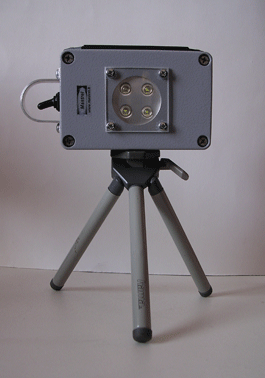
The 4-Superled Ultra Compact Illuminator is designed for filming and photography in caves. Its small size and ease of use make it suitable for every kind of cave.
The aluminium case measures 65x100x35 mm. It takes 4 AA Ni-MH rechargeable batteries, easily swapped through the side battery drawer.
- Type of light
- natural white
- Light output
- 600 lumens
- Beam angle
- about 100 degrees
- Colour temperature
- 5500-6000 K
- Burn time
- about 1 hour
The top loop does two jobs: it lets you clip the illuminator to a cord and it protects the switch from being turned on accidentally in transit. On the back are two 1/4" W threaded holes for brackets or photo tripods.
Tips for use
The illuminator can be used in fresh water down to 2 m, for example to photograph submerged formations.
The battery drawer is not waterproof. To prevent corrosion during storage, take the batteries out and let both the drawer and the compartment dry thoroughly. We recommend white petroleum jelly to protect the battery contacts.
Deeper than 2 m, or in very muddy caves, use a sealed transparent bag: then no maintenance or cleaning will be needed.
For good light output use only Ni-MH or low self-discharge (hybrid) Ni-MH rechargeables (about low self-discharge Ni-MH batteries).
| Distance | Illuminance |
|---|---|
| 5 m | 10 lux |
| 10 m | 2.6 lux |
| 16 m | 1 lux |
Download the illuminator photo tests (in Italian) (PDF, 3.7 MB)
Depth Illuminator

This version of the Ultra Compact Illuminator is designed to give more depth to cave footage and photos. It has the same electrical and mechanical features as the diffused-light model and, with its additional optics, produces a 10° beam with an intensity of 20,000 cd.
During exploration it is very useful for lighting up details in large chambers. On the back are two 1/4" W threaded holes for brackets or photo tripods.
Tips for use
The illuminator can be used in fresh water down to 2 m, for example to photograph submerged formations.
The battery holder is not waterproof. To prevent corrosion during storage, take the batteries out and let both the drawer and the compartment dry thoroughly. We recommend white petroleum jelly to protect the battery contacts. Deeper than 2 m, or in very muddy caves, use a sealed transparent bag: then no maintenance or cleaning will be needed.
For good light output use only Ni-MH or low self-discharge (hybrid) Ni-MH rechargeables (about low self-discharge Ni-MH batteries).
The Depth Illuminator in the Cueva del Rio La Venta (in Italian) (PDF, 231 KB)
Dual Illuminator

This illuminator combines the optics of the Ultra Compact Illuminator and of the Depth Illuminator. The case has the same size and weight as the earlier models (65x100x35 mm, 200 g).
- Diffused light
- 600 lumens, beam about 100°
- Depth light
- 20,000 cd, 10° beam
- Switch
- single three-position switch (light 1 - off - light 2) to choose the most suitable light
Recommended for many underground activities such as exploration, filming and photography, and also for outdoor lighting. It has a 1/4" W threaded hole for brackets or photo tripods.
Tips for use
The illuminator can be used in fresh water down to 2 m, for example to photograph submerged formations.
The battery holder is not waterproof. To prevent corrosion during storage, take the batteries out and let both the drawer and the compartment dry thoroughly. We recommend white petroleum jelly to protect the battery contacts. Deeper than 2 m, or in very muddy caves, use a sealed transparent bag: then no maintenance or cleaning will be needed.
For good light output use only Ni-MH or low self-discharge (hybrid) Ni-MH rechargeables (about low self-discharge Ni-MH batteries).
Maxi Illuminators
New diffused-light Li-Ion Maxi Illuminator
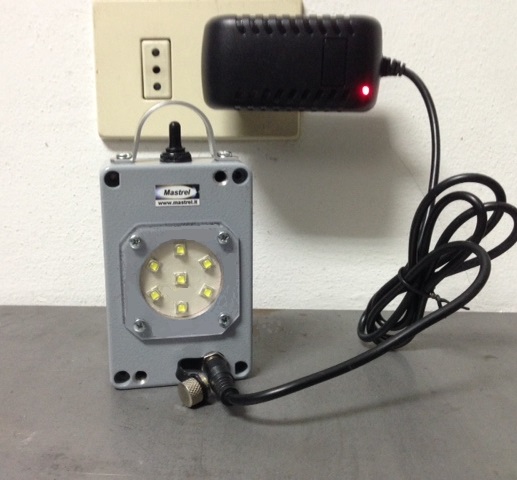
The new Maxi-2 series Maxi Illuminator is currently the top of the Mastrel illuminator range. The new Maxi-2 Superled array gives a diffused light of over 4500 lumens. The light is more intense than on the previous model and the beam angle reaches a full 130 degrees!
And with its low weight and small size it is, to all intents and purposes, a pocket Maxi Illuminator.
It is mainly used at full power in the largest caves but, thanks to its two-position switch, it also has a second 1000-lumen level for smaller spaces or as an emergency light.
It has two 1/4-inch threaded holes for brackets or photo tripods. The Li-Ion battery pack is built in and is charged through a special socket protected by a screw cap. A fast charger is included.
Specifications
- Maximum light output
- 4500 lumens
- Beam angle
- 130°
- Colour temperature
- 5500 K
- Minimum colour rendering (CRI)
- 75
- Maximum burn time
- 60 minutes
- Minimum number of charges
- 500
- Weight
- 400 g
- Dimensions
- 65x100x35 mm
- Water protection
- IP67 (30 minutes under 1-2 metres of water)
| Distance | Illuminance |
|---|---|
| 5 m | 42 lux |
| 10 m | 11 lux |
| 15 m | 5 lux |
| 20 m | 2.5 lux |
| 25 m | 2 lux |
| 30 m | 1.5 lux |
Maxi-2 30 Li-Ion

Same features as the diffused-light Maxi-2, plus special 30° optics designed to give more reach for video and for photos in large chambers.
Features
- Two-level switch: 1000/4500 lumens.
- In very wet caves and underwater, a sealed transparent protective bag is required.
- Two 1/4-inch threaded holes for brackets or photo tripods.
- Built-in Li-Ion battery pack, charged through a special socket protected by a screw cap.
- Fast charger included.
- Burn time: 60 minutes.
- Number of charges: more than 500.
- Maximum light output: 4500 lumens.
- Beam angle: 30°.
- Colour temperature: 5500 K.
- Dimensions: 65x100x35 mm.
- Water protection: IP67 (30 minutes under 1-2 metres of water).
Download Maxi 30 photos - Photos by Mario Cecchi, U.S.P. Prato (ZIP, 2.2 MB)
| Distance | Illuminance |
|---|---|
| 5 m | 410 lux |
| 10 m | 102 lux |
| 15 m | 45 lux |
| 20 m | 25 lux |
| 25 m | 16 lux |
| 30 m | 11 lux |
| 35 m | 8 lux |
| 40 m | 6 lux |
| 45 m | 5 lux |
| 50 m | 4 lux |
| 60 m | 2.8 lux |
| 70 m | 2.1 lux |
| 80 m | 1.6 lux |
| 90 m | 1.2 lux |
| 100 m | 1 lux |
Maxi-2 Double Illuminator

- The Maxi-2 and the Maxi-2 30 in a single case
- Switch 1: 30° spot 4500 lumens - off - 30° spot 1000 lumens
- Switch 2: diffused light 4500 lumens - off - diffused light 1000 lumens
- Built-in rechargeable Li-Ion batteries
- Fast charger (5 hours)
- IP67 water protection rating
Lighting safety when caving
- Test every light, including your spares, at home before the trip.
- Always carry a back-up light, such as an LED headlamp.
- Keep spare batteries in a waterproof container.
- Change batteries in a safe, dry place, so that batteries and other parts of the lamp are not lost or damaged by damp and mud.
- Without the acetylene tube the helmet is no longer "tied on" and can be lost. Always keep the chin strap fastened.